space लेबलों वाले संदेश दिखाए जा रहे हैं. सभी संदेश दिखाएं

10 Immense Things Found In Space


Sure, the oceans are huge and mountains are impressively big. And 7 billion people are a lot of humans, but still. As we all live on planet Earth (with a diameter of 12,742km), it is easily forgotten how incredible tiny we all actually are. All we have to do is look up into the sky at night to realize that we are just a speck of dust in a immensely huge universe. Here’s a list that might bring human grandness back into perspective.
10
Jupiter
Biggest planet (142,984 km diameter)
Jupiter
Jupiter is the largest planet in our Solar System. Ancient Astronomers named Jupiter after the king of the Roman Gods. Jupiter is the 5th closest planet to our sun. The atmosphere of Jupiter consists of about 84 percent Hydrogen and about 15 percent helium, with small amounts of acetylene, ammonia, ethane, methane, phosphine, and water vapor. Jupiter has a mass 318 times greater than the Earth’s and a diameter that is 11 times larger. The mass of Jupiter is 70% of the total mass of all the other planets in our Solar System. Jupiter’s volume is large enough to contain 1,300 planets the size of Earth. The Planet has 63 known satellites (moons) but most of them are extremely small and faint.

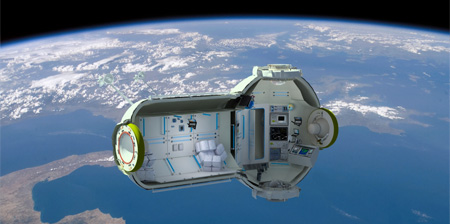
Space Hotel


Russian company Orbital Technologies is planning to open the world’s first space hotel in 2016.
- Innovative hotel will comfortably accommodate up to seven people.


Four private cabins will be equipped with toilets and sealed showers

Top 10 Facts About Space Food


Space may be the final frontier, but it is also one hell of a restaurant. Over the the past half-century, scientists and space engineers have not only been racing to get their rockets safely outside the Earth’s atmosphere, they’ve been working to ensure the menu keeps their astronauts coming back for more. While there have been all sorts of innovations and improvements, it seems now the options are better than ever, to where we might consider studying rocket science just to gain access to NASA’s kitchen. While these days it seems there is little hope in revisiting space any time soon, here are ten facts about space food, to give us food for thought as we wait until we can become weightless once more.
10
Early Space Food
Space-Food-2
Fact: Early Space Food Was Weird.
When Yuri Gagarin become the first human being to go into outer space, he also become the first to eat and do whatever else a human must as a necessary condition of survival. What he ate was stored in toothpaste-like tubes – for instance, his lunch consisted of a liquid paste and chocolate sauce. The first Americans in space – after effectively losing the first phase of the Space Race against the Russians – ate food in cubed, powder, and liquid form (which they really didn’t enjoy at all) and found re-hydrating the freeze-dried foods to be an unpleasant task.

10 Recent Space Discoveries


The better technology gets, the more opportunity we have to learn more about our universe. In recent times, the heavens have opened up to us in ways we used to only imagine. Here is a list of some of the recent space discoveries, in no particular order. Enjoy!
10
New Moons Orbiting Pluto
Hst Pluto Moon4
Pluto now has four known moons. Charon was discovered in 1978, and is the largest of Pluto’s moons. It is 648 miles across, causing many people to consider it and Pluto a “double dwarf planet”. Nothing new was learned of icy bodies orbiting Pluto until 2005, when the Hubble Space Telescope discovered Nix and Hydra. They are both in the range of 20 – 70 miles in diameter. The most amazing discovery regarding Pluto’s moons came in 2011, when Hubble photographed what is temporarily being called P4. It is in the range of 8 – 21 miles in diameter. It is an amazing feat, for Hubble to photograph something that tiny, that is over 3 billion miles away from us.

123