.jpg)
island लेबलों वाले संदेश दिखाए जा रहे हैं. सभी संदेश दिखाएं
island लेबलों वाले संदेश दिखाए जा रहे हैं. सभी संदेश दिखाएं


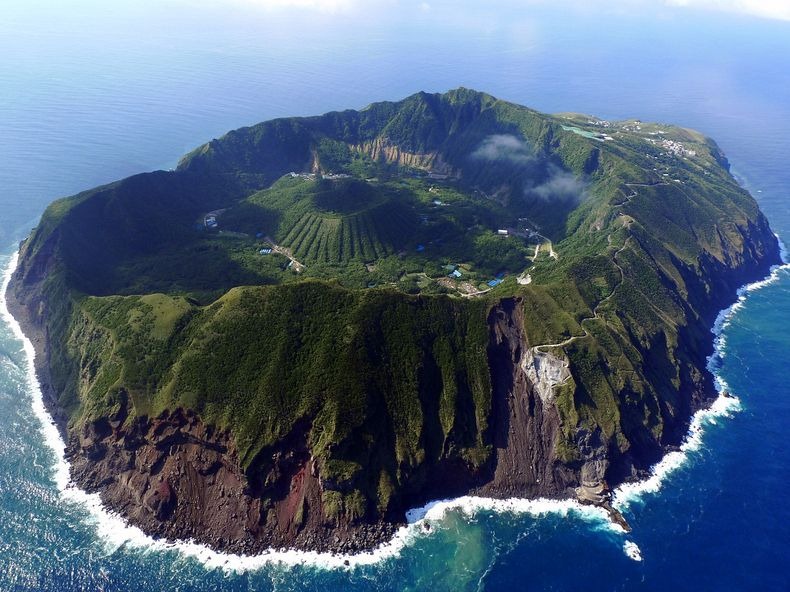
The Inhabited Volcanic Island of Aogashima, Japan
Aogashima is a small, tropical volcanic island in the Philippine Sea, under the administration of Tokyo despite being located some 358 kilometers away from the country’s capital. It is the southernmost and the most isolated inhabited island of the Izu archipelago. The island itself is a giant volcanic crater, and within that crater there’s another, smaller volcano. Aogashima is still considered an active Class-C volcano though it last erupted in the 1780′s. When last erupted it killed nearly half of the island’s population and forced the remaining inhabitants to flee. It took just fifty years for the people to return. Today, some 200 brave villagers live on the island.
The Moving Island of Schiermonnikoog
Schiermonnikoog is a small island off the coast of the Netherlands that has been continuously moving to the south and the east, due to the combining effect of tidal current, prevailing wind and the sea. Just 762 years ago the island lay roughly 2 km to the north of its present position, and it had a significantly different shape. If you work out the math, that is 2.62 meters per year, on average.
The island doesn’t actually move. The sea erodes the island at one end and deposits fresh slit on the other causing the island to shift position and assume a slightly different shape each passing day. There is not much to see in the pictures though and my searches for satellite images documenting the movement of the island drew a blank.

Faroe Islands
The Faroe Islands is a group of 18 islands in the middle of the North Atlantic Ocean, northwest of Scotland and halfway between Iceland and Norway. The Islands have a population of nearly 50,000 and a language and culture of their own. The Faroe Islands are undeniably beautiful: green, rugged and wind-swept. The countryside is dominated by steep mountains, vertical sea cliffs and picturesque valleys. During summer, the Faroe Islands turn extraordinarily green and this is usually the best time to visit.
There are over a hundred villages in the Faroe Islands. Nearly every single one of them is situated near the ocean, and to new visitors they may all seem to be very much alike. The houses are either painted in bright colours or the traditional black, whilst the roofs are often turf covered. The buildings are usually built very close to each other, which is very cosy. In most places sheep occupy the outfield throughout the whole year.
Although the history of the Faroe Islands dates back to the 6th century, towns didn’t start to appear until very late. For instance, the capital, Tórshavn, only counted about 100 inhabitants in 1900, whereas today the number has escalated into nearly 20,000. In the Faroe Islands the traditional village was to a certain extent self-sufficient. When the fishing industry took off in 1872, it was the beginning of the end for the traditional way of life in the small villages as fishing replaced farming and the growing population chose to settle in the fast growing towns instead.

Famous Island Owners
There is nothing more exclusive and sought after in the world than having your own private island; it becomes effectively your own little kingdom. Owning an island is the ultimate status symbol; apart from that, who are always in the public eye.
Marlon Brando- Tetiaroa, French Polynesia, Tahiti

Marlon Brando first “discovered” Tetiaroa in the early 1960′s while scouting locations for the classic film “Mutiny on the Bounty”. The atoll is located 33 miles (53 km) north of Tahiti. The atoll stretches on a total surface of 2.3 square miles (6 square km); approximately 1,445 acres (585 hectares) of sand are divided in 13 motus (islets) with varying surface areas. The lagoon is approximately 4.5 miles (7 km) wide and 100 feet (30 meters) deep. The atoll has no reef opening, making access by boat nearly impossible.
10 Most Crowded Islands of the World
Human beings are an amazing species. Given enough time, they will multiply, relocate and establish even on the most remote corners of the world. The following islands, I’m sure, were once uninhabited full of lush green forest, beautiful beaches and perhaps an animal or two. Today, entire cities stands on them. But unlike communities on mainland, land and resources on an island are scarce. With no space to grow geographically these islands are crushingly dense with people and housing.
Here is a collection of some of the most populous island in the world.

सदस्यता लें
संदेश (Atom)