festival लेबलों वाले संदेश दिखाए जा रहे हैं. सभी संदेश दिखाएं
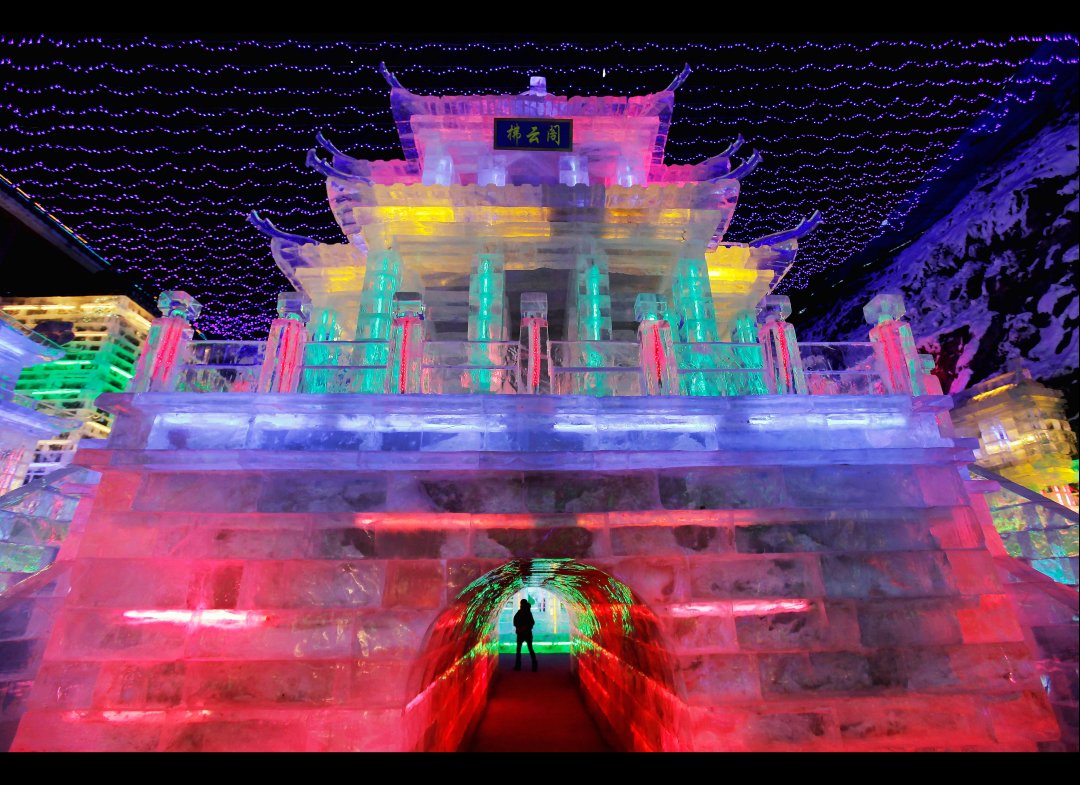
Chinese Lantern Festival

A visitors view ice sculptures at Yanqing Ice Festival also for the Chinese Lantern Festival which falls on February 6 and traditionally marks the end of the Lunar New Year celebrations in Beijing, China Feb. 6, 2012. The Lantern Festival also known as the Yuanxiao Festival or Shangyuan Festival in China.
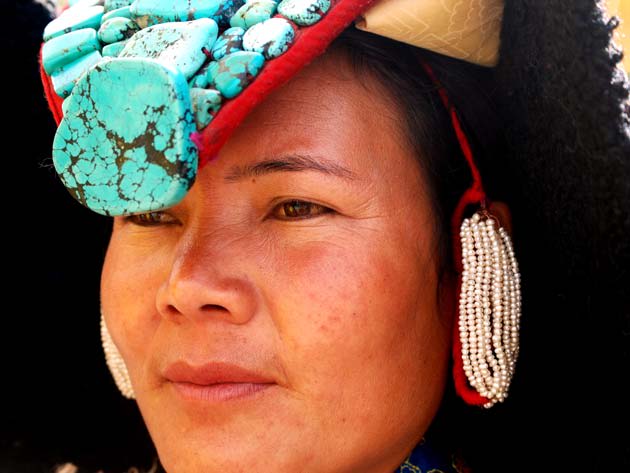
The Ladakh festival
The Ladakh festival, held every year from September 1 – 15, showcases the people, customs and traditions of this remote and beautiful land.

Taiwan’s Boat Burning Festival

Taoist festivals don't get much bigger, brighter or more spectacular than Taiwan's Burning of the Wang Yeh Boats. Every three years in October or November, the southern port town of Donggang feasts and fetes a handful of Chinese gods for nine days before sending them off to heaven in a fiery blaze aboard a Chinese junk. (Robert Kelly)
Boryeong Mud Festival 2012, South Korea
The Boryeong Mud Festival is an annual festival which takes place during the summer in Boryeong, a town around 200 km south of Seoul, South Korea. The first Mud Festival was staged in 1998 and, by 2007, the festival attracted 2.2 million visitors to Boryeong. The mud of Boryeong mud flats is considered to be rich in minerals and is actually used to manufacture cosmetics. In fact, the festival was conceived to promote a range of cosmetics that were produced using mud from the Boryeong mud flats. The festival has grown incredibly popular ever since.
In 1996 a range of cosmetics was produced using mud from the Boryeong mud flats. The cosmetics were said to be full of minerals, bentonites, and germaniums, all of which occur naturally in the mud from the area. In order to promote these cosmetics, the Boryeong Mud Festival was conceived. Through this festival, it was hoped people would learn more about the mud and the cosmetics. The festival has become popular with both Koreans and western tourists, as well as American Military personnel stationed in the country, and foreign English teachers working in Korea.
Although the festival takes place over a period of around two weeks, it is most famous for its final weekend, which is popular with Korea's western population. Boryeong Mud Festival runs from July 14 until the July 24.
Sunflower Festival in Zama, Japan
Zama is a city located in central Kanagawa Prefecture, Japan, famous for its extensive sunflower fields. Every year in summer the flowers bloom and during this time the annual Sunflower Festival or Himawari Matsuri is organized. From late July through August more than half a million sunflowers are displayed at various locations around Zama.
During the festival, visitors can enjoy music and entertainment, great food and buy farm fresh produce. An array of sunflower products, from Sunflower seeds to Sunflower beer and sunflower pasta are sold at the festival. The plants grow pretty tall - over 5 feet. A raised platform is built at the edge of the field enabling visitors to take elevated pictures of the entire sunflower field.
The sunflower, which is indigenous to America, were brought to Europe in the 16th century, where, along with sunflower oil, they became a widespread cooking ingredient. Sunflower leaves aren’t wasted, either, being used for cattle feed and the fibrous stems for paper production. Sunflowers also has a peculiar ability to extract toxic ingredients from soil, such as lead, arsenic and uranium. After the Fukushima nuclear disaster last year, volunteers and campaigners in Japan grew sunflowers to decontaminate the radioactive soil. A similar campaign was mounted in response to the Chernobyl disaster in Russia.
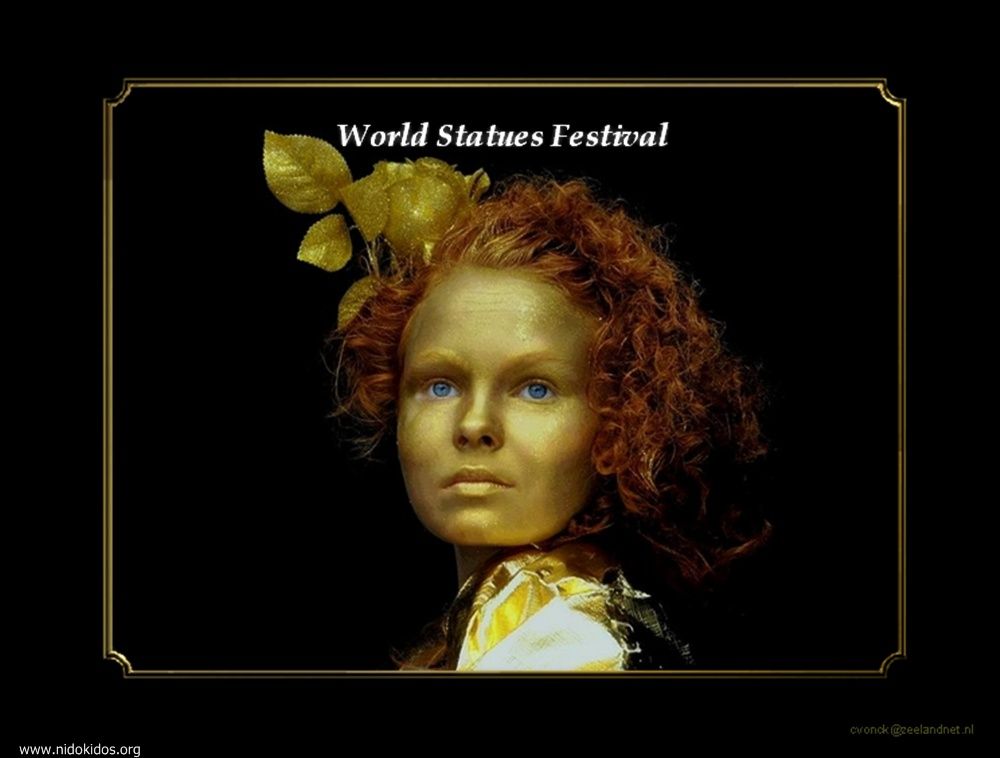
Festival statue
The Aim of the festival
1) The mission of the festival is to create the space for the meeting of students and other theatre professionals from theatre schools.
2) The festival is a part of the educational system from, The Theatre Faculty of Janacek Academy of Music and Performing Arts. Organizers
1) The main organiser of the festival is The Theatre Faculty of Janacek Academy of Music and Performing Arts.
2) Also, other subjects can participate in organising the festival. The contract of cooperation and other agreements deal with the content and form of the co-operation. Project

1) The mission of the festival is to create the space for the meeting of students and other theatre professionals from theatre schools.
2) The festival is a part of the educational system from, The Theatre Faculty of Janacek Academy of Music and Performing Arts. Organizers
1) The main organiser of the festival is The Theatre Faculty of Janacek Academy of Music and Performing Arts.
2) Also, other subjects can participate in organising the festival. The contract of cooperation and other agreements deal with the content and form of the co-operation. Project

8 Wacky Festivals Celebrated in the Month of June
We have seen many strange festivals, customs and rituals followed by people in various countries and culture. Thousands of years of human existence, society, belief and superstition has given them shape, while others are celebrated for pure amusement. In this article, we will look at some bizarre festivals that are celebrated in the month of June.
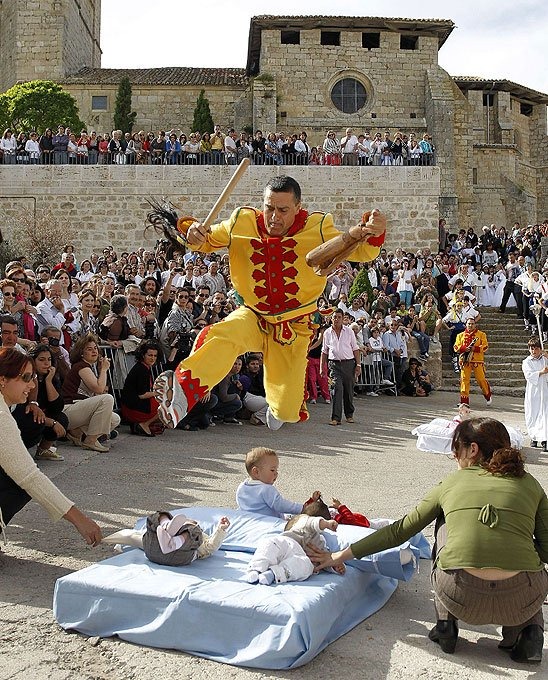
Baby Jumping Festival of El Colacho
Every year during the month of June, the Spanish village of Castrillo de Murcia near Burgos holds its traditional Baby-Jumping Festival as part of its Corpus Christi celebrations. During the act, known as El Colacho, men dressed as the Devil (known as the Colacho) leaps over babies born during the previous twelve months of the year who lie on mattresses in the street.
The Catholic festival of Corpus Christi is celebrated all over Spain with processions, mystery plays and a wide variety of popular celebrations, but this bizarre tradition is seen only in Castrillo de Murcia. The tradition dates back to 1620, although the origins are vague. It is believed that as the incarnate devils jump they take all their evil with them and the children are cleansed.
Kiev Fire Festival 2012
For the sixth year in a row, the Kiev International Fire Festival was held in the capital city of Kiev, Ukraine, on 25th-26th of May 2012. Those who attended got the chance to see the astonishing fire show performed by talented fire artist of the country and abroad. In addition to the fire show at the big stage there were also circus and theatrical performances, the alternative scene, graffiti challenge, circus and fire fair, fire and drum schools.
This year the festival's program included performances of theaters and solo artists from France, Germany, Czech Republic, Hungary, Lithuania as well as artists from the CIS countries.
Gawai Dayak Celebration
Gawai or Gawai Dayak is a festival celebrated in Sarawak and West Kalimantan on 1 June every year. It is both a religious and social occasion. The word Gawai means a ritual or festival whereas Dayak is a collective name for the native ethnic groups of Sarawak which are the Iban, also known as Sea Dayak and the Bidayuh people, also known as Land Dayak. Thus, Gawai Dayak literally means “Dayak Festival”. Dayak would visit their friends and relatives on this day. Such visit is more commonly known as “ngabang” in the Iban language.
The mode of celebration varies from place to place. Preparation starts early. Tuak (rice wine) is brewed (at least one month before the celebration) and traditional delicacies like penganan (cakes from rice flour, sugar and coconut milk) are prepared. As the big day approaches, everyone will be busy with general cleaning and preparing food and cakes. On Gawai Eve, glutinous rice is steamed in bamboo (ngelulun pulut). In the longhouse, new mats will be laid out on the ruai (an open gallery which runs through the entire length of the longhouse). The walls of most bilik (rooms) and the ruai are decorated with Pua Kumbu (traditional blankets). A visit to clean the graveyard is also conducted and offerings offered to the dead. After the visit it is important to bathe before entering the longhouse to ward off bad luck.
Insane Festivals From Around The World
From birthdays to new years every culture has its fair share of things to celebrate. While in most parts of the world you’ll find that the celebrations have at least a few things in common (eating, drinking, dancing) many times the similarities stop there. Where some people like to complement the festivities with throwing goats out of towers others prefer driving skewers through their faces. Whatever helps you get your party on right? Well prepare for some culture shock because these are the 25 most insane festivals from around the world.
10 Most Incredible Flower Festivals Around the World
Flower festivals are celebrated all over the world and almost around the year. Even as I write this one such festival is taking place in India, the Malabar Flower Festival, and another scheduled to start later this month. The Kegworth Flower Festival is underway in Derby, England, and a dozen other places are preparing for theirs in the coming weeks. Here we present 10 most fascinating display of flowers in different parts of the world.
Bloemencorso
The Bloemencorso, a Dutch word which means "flower parade", are held in many towns in the Netherlands and Belgium. In a parade of this kind the floats, cars and in some cases boats are magnificently decorated or covered in flowers. Each parade has its own character, charm and theme. Zundert holds the largest flower parade in the world.
The parade takes place on the first Sunday of September. The floats are large artworks made of steel wire, cardboard, papier-mâché and flowers. In the Bloemencorso Zundert, only dahlias are used to decorate the objects and it takes thousands of them just to cover one float.
The huge floats are made by twenty different hamlets and each of them consists of hundreds of builders, aged 1 to 100, who are all equally crazy about the bloemencorso. The older members of the hamlet are often responsible for planting and growing the dahlias, while the younger ones build the float in large temporary tents that are built exclusively for the event.
Turning Of The Bones- Famadihana Festival
According to Malagasy belief, people are not made from mud, but from the bodies of the ancestors. Hence they hold their forefathers in high regard. They also believe that unless the bodies decompose completely, the dead do not leave permanently and are able to communicate with the living. So until they are gone forever, love and affection is showered on them through the Famadihana festival. Famadihana, also known as ‘turning of the bones’ is a festival celebrated every 2 to 7 years. The main motive behind the festival originated from the belief of the local people that the dead return to God and are again reborn. Dead people are highly respected in the local communities as they are considered to be directly related to God. It is interesting to note that the festival is not an ancient practice of Madagascar. Its origins cannot be traced beyond the seventeenth century.

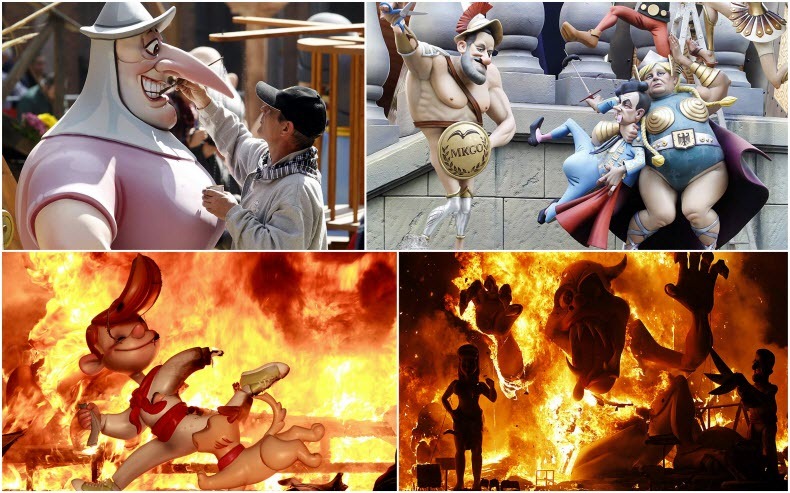
Las Fallas, the Festival of Fire Celebrated in Valencia
Every year the city of Valencia in Spain celebrates the ancient "Las Fallas" fiesta, a noisy week that is full of fireworks and processions in honor of Saint Joseph which climaxes in the burning of large papier mache figures displayed around the streets of the city.
Las Fallas is celebrated to commemorate St. Joseph's Day, the Patron Saint of Carpenters. Las Fallas literally means "the fires" in Valencian. The focus of the fiesta is the creation and destruction of ninots (“puppets” or “dolls”), which are huge cardboard, wood, paper-machè and plaster statues. The ninots are extremely lifelike and usually depict bawdy, satirical scenes and current events. A popular theme is poking fun at corrupt politicians and Spanish celebrities. The labor intensive ninots, often costing up to US$75,000, are crafted by neighborhood organizations and take almost the entire year to construct. Many ninots are several stories tall and need to be moved into their final location of over 350 key intersections and parks around the city with the aid of cranes on the day of la plantà (the rising).
The ninots remain in place until March 19th, the day known as La Cremá (the burning). Starting in the early evening, young men with axes chop cleverly-hidden holes in the statues and stuff them with fireworks. The crowds start to chant, the streetlights are turned off, and all of the ninots are set on fire at exactly 12am midnight. Over the years, the local bomberos (firemen) have devised unique ways to protect the town's buildings from being accidentally set on fire by the ninots: such as neatly covering storefronts with fireproof tarps. Each year, one of the ninots is spared from destruction by popular vote. This ninot is called the ninot indultat (the pardoned puppet) and is exhibited in the local Museum of the Ninot along with the other favorites from years past.
See last photos of last year’s celebration.
The brutal festival at Nem Thuong village,Vietnam
This is one Vietnamese festival that makes even non animal lovers cringe. Every year, at a village near Hanoi, a pig is brutally chopped into two so that people can smear banknotes with its blood in the belief that it would bring luck. Viewer discretion is advised while viewing these photos.

सदस्यता लें
संदेश (Atom)


.jpg)
.jpg)