Rare Pictures Related to the Life of Hazrat Muhammad (PBUH)


 Rare Pictures Related to the Life of Hazrat Muhammad (PBUH)


Grave of Haleema (RA)
Grave of Hazrat Safia (RA)
Grave of Hazrat Hamza (Uncle of Muhammad (PBUH))
Jable-E-Rehamt
Jabl-E-Rehmat

Birth Place of Muhammad (PBUH)
Birth place of Muhammad (PBUH)
This place is converted to Library Now.
Hira Mount (Where Muhammad PBUH used to pray)
Mount Saur (Where Hazrat Abu Bakr and his friends lived
When Kufar of Makkah were after him and a Spider made
a net on the entrance of Mount)
Hair of the Beard of Hazrat Muhammad (PBUH)
A hair from the Beard of Hazrat Muhammad (PBUH)


(Click on the image to Enlarge the View)


Seal of Hazrat Muhammad (PBUH)


Single Grave Hazrat Fatima Zuhra (RA)

Swords of Hazrat Muhammad (PBUH)


Swords of Hazrat Muhammad (PBUH)

Click on the image to Enlarge
Naksh-E-Qadam(Foot Print) of Hazrat Muhammad (PBUH)
Grave of Mother Amna Bibi of Hazrat Muhammad (PBUH)
Hazrat Muhammad's (PBUH) Clothes Turban(Umama) and stick

Grave of Safia Mother of Ali-Umm-Al-Banin

Letter of Hazrat Muhammad (PBUH) to Ommani People

Letter of Hazrat Muhammad (PBUH) to Emporer

Letter of Hazrat Muhammad (PBUH) to Ruler of Bahrain

Letter of Hazrat Muhammad (PBUH) to Ruler of Bahrain

Naksh-E-Qadam(Foot Print) of Hazrat Muhammad (PBUH)

Magic,card under the ice.


Magic,card under the ice.


Would you believe this...


Amazing Bird Flying

Amazing Bird Flying 


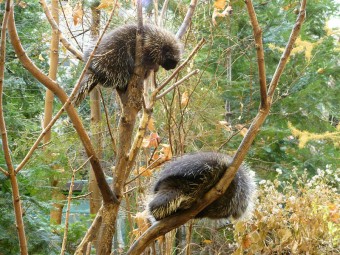
How Porcupines Mate


How Porcupines Mate

Porcupines mate in a very bizarre way. They first begin their ludicrous lovemaking with some nose rubbing. If the female accepts the nose rubbing and, after the initial nose rubbing test, the female is still keen on the male, the male will then stand on its hind legs and the female allows him to urinate all over her body (kinky).  This isn’t done in a normal bladder expelling fashion, though. In this case, the urine is ejaculated at high pressure, rather than relying on internal bladder pressure.

Should this golden shower not be up to the female’s standards (she doesn’t like the pheromones), she will shake off the urine and find herself another mate. Should the rain from the main vein be acceptable, she will expose her non-quilled underbelly and allow the male to copulate for 2-5 minutes. If all is successful, approximately 112-210 days later (depending on the species) a little porcupine baby is born.
This mating ritual is not only strange, but also is infrequent. Female porcupines are receptive to sexual advances for only about 8-12 hours per year, much like my ex-wife.  This mating typically occurs in late summer or early fall.  They do however take full advantage of that time. Females will mate several times with the male of their choice until he becomes sexually exhausted.
Interestingly, unlike many female animals that are frequently raped (such as with ducks where an estimated 1 in 3 mating acts is rape), the female porcupine cannot be raped.  All she has to do to deter a potential rapist is to swipe his mating-ready exposed sensitive region with her tail, problem solved.  So male porcupines are completely at the mercy of the female when it comes to mating.  They also tend to have a tough time of it just to get to mate, generally having to chase off other male porcupines to win the right to mate with the female.  This process often results in them getting stuck with quills during the fighting, even if they win.
Bonus Factoids:
  • Porcupines are the third largest rodent on earth. They range from 25-36 inches long and weigh between 12-35 pounds. Only the beaver and capybara are larger in the rodent kingdom.
  • Porcupines are in constant need of salt and will stop at nothing to get at it. They are considered pests primarily for this very reason, gnawing on and destroying anything that has salt on or in it. This includes even small amounts of salt, like anything that salty human hands have touched, such as the handles of tools, discarded garbage, or food wrappers. The most common item destroyed by these rodents is plywood. The curing compound used in plywood production is sodium nitrate. The porcupine sniffs this out and will chew relentlessly at any wooden wall, floor, roof, or structure made from it.
  • Baby porcupines are born with their eyes open and very well developed. Their quills are soft directly after birth (which I’m sure the mother appreciates) but will harden within about an hour. They are dependent on their mother’s milk for about 8 weeks and then begin to eat normally. They can expect a life span of about 20 years.
  • The warning and defensive method of a porcupine is a threefold system. They will first begin to shake their quills in a visible pattern and send out an unpleasant odor. If you still won’t back off, they will begin to stamp their feet and will also growl and clack their teeth. Should you ignore these first two signs, the porcupine will then turn its back to you and charge at you backwards. Should they make contact, the quills are your Darwin-Award for inattention to warning signs.
  • A common misconception is that porcupines can “throw” their quills.  In fact, this is not an ability they possess (luckily).
  • Evolution has developed an ingenious method for the release of quills. There is a thick loop of connective tissue that surrounds the follicle and attaches it to the skin. When relaxed, this tissue is soft and only loosely holds the quill in place. When attacked by a predator, a porcupine becomes stressed and the muscles around the connective tissue tighten and cause the quills to become erect. Once erect, the quills can deeply penetrate the skin and the tightened muscles make it easier to detach the quill. Specifically, research has shown that the tightened muscles make it 40% easier to detach the quill then if the connective tissue was loose.
  • Porcupine quills are just specialized hairs ranging from ½ inch to 4 inches thick. These hairs are coated with a thick layer of keratin (similar to fingernails) with several small layers of barbs at the tip. This will allow the barb to penetrate deeper once embedded. There are about 30,000 of them on any one porcupine. They occupy every part of the body except the face, inner parts of the limbs and the stomach. The longest quills are on the butt, and the smallest are on the cheeks.
  • Porcupine quills are a good luck charm in many parts of Africa and the hollow portions have been used as musical rattles or containers for gold dust. Don’t think all parts of Africa are in love with this strange rodent though. In 2005, there was such an infestation that the Kenyan people pleaded with the government to control the problem. Local farmers stated they had several years of unusable crops due to porcupines, and local graveyards complained of numerous graves that were burrowed into and used as dens for the creatures. Ever the innovative people, some Kenyans saw this opportunity to make lemonade from lemons and created a new delicacy with the vermin.
  • The best way to remove a porcupine quill is to take a pair of common household pliers and pull the quill directly out. Be careful not to break off any part of it, but if you do, don’t worry, quill tips are coated with antibiotic fatty acids that help in healing. And don’t worry that the porcupine will be left defenseless by releasing too many quills. They grow back within a month or two.


Caerostris Darwini: Incredible Madagascar Spider


Caerostris Darwini: Incredible Madagascar Spider


Darwin’s bark spider (Caerostris darwini) is an orb-weaver spider that produces one of the largest known orb webs, web size ranged from 900–28,000 cm2, with anchor lines spanning up to 25 metres (82 ft). The spider was discovered in Madagascar in the Andasibe-Mantadia National Park in 2009. The species was named in honour of the naturalist Charles Darwin, with the description being prepared precisely 150 years after the publication of The Origin of Species, on 24 November 2009. Its silk is the toughest biological material ever studied, over ten times tougher than a similarly-sized piece of Kevlar. The average toughness of the fibres is 350 MJ/m3, and some are up to 520 MJ/m3, making the silk twice as tough as any other spider silk known. The web of Darwin’s bark spider is remarkable in that it is not only the longest spanning web ever observed, but is among the largest orb webs ever seen, at an area of up to 2.8 square metres (30 sq ft). Nephila komaci, discovered in 2009, and some other Nephila species also make webs that can exceed 1 m (3 ft 3 in) across.

Caerostris Darwini: Incredible Madagascar Spider   animals 2

Babies Calendar 2012


Babies Calendar 2012


babies-calendar- (1)

 babies-calendar- (2)

babies-calendar- (3)

babies-calendar- (4)

babies-calendar- (5)

babies-calendar- (6)

babies-calendar- (7)

babies-calendar- (8)

babies-calendar- (9)

babies-calendar- (10)

babies-calendar- (11)

babies-calendar- (12)

123