What Colors Mean In Different Cultures


Ah colors. Though it’s only reflected light emitting different frequencies of the photon wave spectrum, colors are often much more than just that. For many they can describe emotions, nations, ideas, or even memories. In the art world, color can be a crucial element in the expression of a painter (Rothko) But just like many other cultural discrepancies, the meaning of color tends to change as you move around the globe. This infographic aims to tackle the very subject of how we associate colors with various feelings and ideas of different cultures around the world.
Dividing into 10 subgroups – Western/American, Japanese, Hindu, Native American, Chinese, Asian, Eastern European, Muslim, African, and South American, these broad regions are divided on this circular graph to show how each culture would choose to represent a facet of emotion or idea by color. Some are unanimous – Red for passion, black as evil – while others are completely different – Respect ranges from grey to white to silver to gold depending on which region of the world you are from. Of course it cannot be denied that color is a subjective device and there are many subcultures that probably dispute their assigned colors; it must be said – colors do have meaning. For whatever reason, humans desire to represent themselves by color and commonly create manifestations of daily life within these colors. Except the color-blind. I don’t know what the hell they think about any of this. via

Most Expensive Things in the World


Backwaters of Kerala


Kerala, a state in southern India, is well-renowned for its backwater system – a network of interconnected canals, lagoons, rivers, lakes and inlets that run inland from the coast and which is spread over an extensive 900 km. The network includes five large lakes linked by canals, both manmade and natural, fed by 38 rivers, and extending virtually half the length of Kerala state. Traditionally, the backwaters are used by local people for transport, fishing, and agriculture. Annual snake boat races, held along the backwaters, also provide a great source of entertainment for the locals and tourists alike. The lagoons and lakes is a lasting source of livelihood for the indigenous people and a popular tourist attraction for the state.
The backwaters were formed by the action of waves and shore currents creating low barrier islands across the mouths of the many rivers flowing down from the Western Ghats range. Fed by the rivers, the backwaters are almost free of salty seawater. In certain areas, such as the Vembanad Kayal, artificial barrage has been built to prevent salt water from the sea from entering the deep inside, keeping the fresh water intact.
kerela-backwaters-5

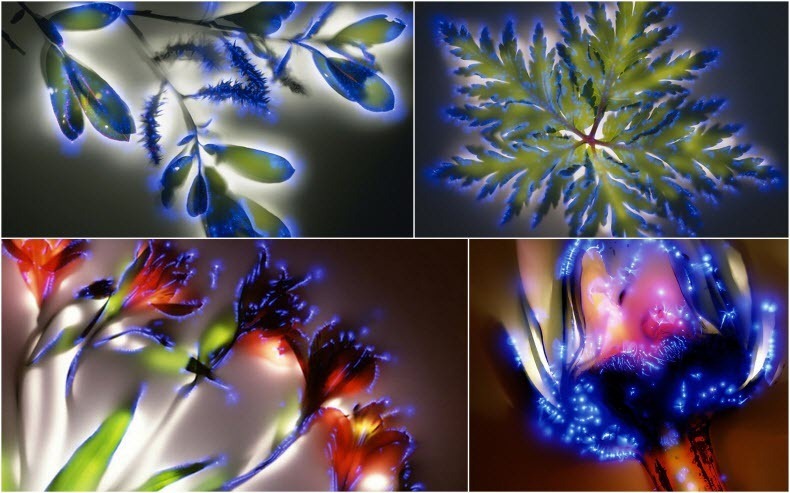
Electrifying Images of Electrocuted Flowers


San Francisco Bay Area photographer Robert Buelteman takes extraordinary images of flowers subjected to 80,000 volts of electricity. But he doesn’t use traditional equipment, not even a camera.
Buelteman's technique is an elaborate extension of what is know as Kirlian photography made popular in the late 1930s. Named after Russian inventor Semyon Davidovich Kirlian, it consists of applying a high voltage electric field near a photographic plate, which result in the appearance of coronal discharges called Kirlian auras surrounding the object being photographed.
Wired.com explains his technique in more detail:
Buelteman begins by painstakingly whittling down flowers, leaves, sprigs, and twigs with a scalpel until they're translucent. He then lays each specimen on color transparency film and, for a more detailed effect, covers it with a diffusion screen. This assemblage is placed on his "easel"—a piece of sheet metal sandwiched between Plexiglas, floating in liquid silicone. Buelteman hits everything with an electric pulse and the electrons do a dance as they leap from the sheet metal, through the silicone and the plant (and hopefully not through him), while heading back out the jumper cables. In that moment, the gas surrounding the subject is ionized, leaving behind ethereal coronas. He then hand-paints the result with white light shining through an optical fiber the width of a human hair, a process so tricky each image can take up to 150 attempts.
Kirlian-photography1

Zlatni Rat


The Golden Horn, also called Zlatni Rat, is the most spectacular of Croatia's beaches. This vast, golden pebble beach, almost 580 yards long, juts out into the water like a white tongue stretched into the sea. The tip of the beach changes shape and position, depending on the wind. Surrounded by pine wood and crystal clear sea, this beach stands out with its fascinating beauty.
Situated at the south eastern edge of the Croatian island Brač, near Bol, this beach became, throughout the years, the favorite spot for tourists both Croatian and foreign. The beach attracts tourists from all over the world, who enjoy the sun, the sea and water sports.
The Golden Horn offers a wide range of water sports, including jet-ski, SSI scuba-diving, banana boats, as well as parachute rides, beach volley and many other fun things. For those who just want to relax, away from the scorching sun rays, the nearby pine forest represents a perfect retreat.
Zlatni-rat-0

Incredible Cloud Formations


Lenticular Clouds

Sunflower Festival in Zama, Japan


Zama is a city located in central Kanagawa Prefecture, Japan, famous for its extensive sunflower fields. Every year in summer the flowers bloom and during this time the annual Sunflower Festival or Himawari Matsuri is organized. From late July through August more than half a million sunflowers are displayed at various locations around Zama.
During the festival, visitors can enjoy music and entertainment, great food and buy farm fresh produce. An array of sunflower products, from Sunflower seeds to Sunflower beer and sunflower pasta are sold at the festival. The plants grow pretty tall - over 5 feet. A raised platform is built at the edge of the field enabling visitors to take elevated pictures of the entire sunflower field.
The sunflower, which is indigenous to America, were brought to Europe in the 16th century, where, along with sunflower oil, they became a widespread cooking ingredient. Sunflower leaves aren’t wasted, either, being used for cattle feed and the fibrous stems for paper production. Sunflowers also has a peculiar ability to extract toxic ingredients from soil, such as lead, arsenic and uranium. After the Fukushima nuclear disaster last year, volunteers and campaigners in Japan grew sunflowers to decontaminate the radioactive soil. A similar campaign was mounted in response to the Chernobyl disaster in Russia.
himwari-festival-0

123