A sea monster


A sea monster ... and he’s still a nipper! Monster Tasmanian King Crab saved from the pot and shipped to Britain for aquarium display

  • Claude weighs a mighty 15lbs and measures 15 inches wide and would have produced 20lbs worth of meat
  • He was destined for the pot – if they had found one big enough to fit.
But Claude the Tasmanian giant crab was saved from death when the fisherman who caught him sold him to a British aquarium  for £3,000.
Now, after a 29-hour plane journey from Australia – where giant crab meat is a delicacy – and two weeks in quarantine, Claude is ready to meet his public.
Catch of the day: Claude weighs a mighty 15lbs and measures 15 inches wide - when he is fully grown he will weigh a whopping 30lbs and gain an extra three inchesCatch of the day: Held up by Sealife aquarist Jemma Battric, Claude weighs a mighty 15lbs and measures 15 inches wide - when he is fully grown he will weigh a whopping 30lbs and gain an extra three inches

Super-Kamiokande Neutrino Detector in Japan


Neutrinos are some of the most abundant yet mysterious particles in our universe. Every second 65 billion neutrinos pass through every square centimeter of our body and the Earth. Neutrinos do not carry electric charge, which means that they are not affected by the electromagnetic forces that act on charged particles such as electrons and protons. They are also extremely tiny because of which they travel mostly undisturbed through matter. This makes neutrinos extremely hard to detect, and the harder a particle is to detect, the more massive and sophisticated the detectors have to be. The Super Kamiokande in Japan is one such neutrino observatory.
The Super Kamiokande or Super-K for short is located 1,000 meters underground in the Mozumi Mine in Hida's Kamioka area. The observatory was designed to search for proton decay, study solar and atmospheric neutrinos, and keep watch for supernovae in the Milky Way Galaxy. The observatory was built underground in order to isolate the detector from cosmic rays and other background radiation.
The observatory consists of 50,000 tons of pure water in cylindrical stainless steel tank that is 41.4 meters tall and 39.3 meters in diameter. This is surrounded by 11,146 photomultiplier tubes (PMT). When a neutrino interacts with the electrons or nuclei of water, it produces a charged particle that moves faster than the speed of light in water (not to be confused with exceeding the speed of light in a vacuum, which is physically impossible). This creates a cone of light known as Cherenkov radiation, which is the optical equivalent to a sonic boom. The Cherenkov light is projected as a ring on the wall of the detector and recorded by the PMTs. The distinct pattern of this flash provides information on the direction and flavor of the incoming neutrino.
super-kamiokande-3

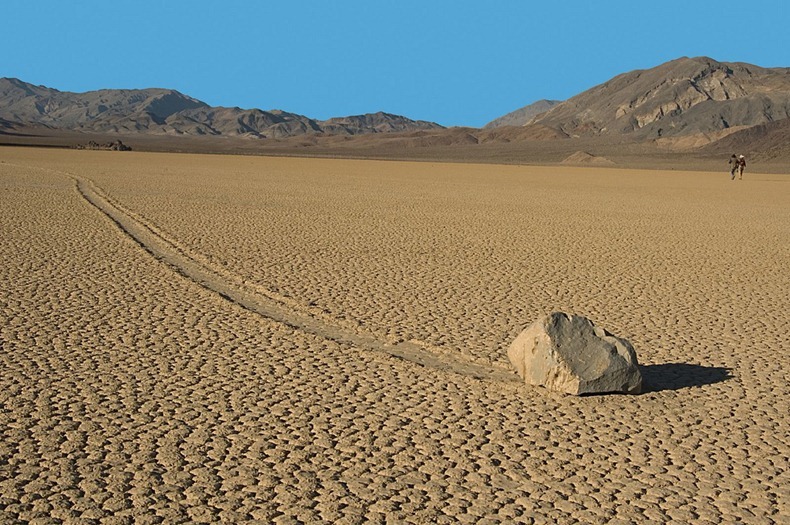
The Mysterious Sailing Stones of Racetrack Playa


The Racetrack Playa is an exceptionally flat and dry lakebed located above the northwestern side of Death Valley, in Death Valley National Park, California. The playa is best known for one of the most strangest mysteries of the planet – the sliding rocks. These rocks can be found on the floor of the playa with long trails behind them. Although no one has actually seen the rocks move, the long meandering tracks left behind in the mud surface of the playa attest to their activity. Some of these rocks weigh several hundred pounds and have traveled as far as 1,500 feet, which leaves us with the question: "How do they move?"
The stones move only every two or three years and most tracks develop over three or four years. Stones with rough bottoms leave straight striated tracks while those with smooth bottoms wander. Stones sometimes turn over, exposing another edge to the ground and leaving a different track in the stone's wake.
Trails differ in both direction and length. Rocks that start next to each other may travel parallel for a time, before one abruptly changes direction to the left, right, or even back the direction it came from. Trail length also varies – two similarly sized and shaped rocks may travel uniformly, then one could move ahead or stop in its track.
sailing-stones-death-valley-3

Positions Of Love- Lana Sutra By Erik Ravelo


Language, culture, place, values and tradition; they all create a separation which we call differences or diversity. Erik Ravelo is a Cuban artist at Fabrica who has viewed those differences as the palette to break down and dissolve those differences. In his latest work, Lana Sutra, with United Colors of Benetton, his experiences concerning diversity shaped and unified the convergence on diversity, love.
“I believe that Lana Sutra really talks about coexistence, about living together. It is about interaction among cultures and people of different races and faiths. It’s an ode; a homage to hybridization.”

Las Fallas, the Festival of Fire Celebrated in Valencia


Every year the city of Valencia in Spain celebrates the ancient "Las Fallas" fiesta, a noisy week that is full of fireworks and processions in honor of Saint Joseph which climaxes in the burning of large papier mache figures displayed around the streets of the city.
Las Fallas is celebrated to commemorate St. Joseph's Day, the Patron Saint of Carpenters. Las Fallas literally means "the fires" in Valencian. The focus of the fiesta is the creation and destruction of ninots (“puppets” or “dolls”), which are huge cardboard, wood, paper-machè and plaster statues. The ninots are extremely lifelike and usually depict bawdy, satirical scenes and current events. A popular theme is poking fun at corrupt politicians and Spanish celebrities. The labor intensive ninots, often costing up to US$75,000, are crafted by neighborhood organizations and take almost the entire year to construct. Many ninots are several stories tall and need to be moved into their final location of over 350 key intersections and parks around the city with the aid of cranes on the day of la plantà (the rising).
The ninots remain in place until March 19th, the day known as La Cremá (the burning). Starting in the early evening, young men with axes chop cleverly-hidden holes in the statues and stuff them with fireworks. The crowds start to chant, the streetlights are turned off, and all of the ninots are set on fire at exactly 12am midnight. Over the years, the local bomberos (firemen) have devised unique ways to protect the town's buildings from being accidentally set on fire by the ninots: such as neatly covering storefronts with fireproof tarps. Each year, one of the ninots is spared from destruction by popular vote. This ninot is called the ninot indultat (the pardoned puppet) and is exhibited in the local Museum of the Ninot along with the other favorites from years past.
las-fallas
See last photos of last year’s celebration.

Incredible Glasswinged Butterfly


Most common English name for this incredible butterfly(Greta Oto) is glasswinged butterfly, and its Spanish name is “espejitos”, which means “little mirrors.” Indeed, the tissue between the veins of its wings looks like glass, as it lacks the colored scales found in other butterflies. The opaque borders of its wings are dark brown sometimes tinted with red or orange, and its body is dark in color.
Incredible Glasswinged Butterfly

Athletes Are Able To Run Faster After Eating Beetroot


Eating beetroot can boost athletic performance, research has suggested, by helping runners finish faster.

Scientists have discovered athletes who eat baked beetroot before a race run put in a faster time.

The purple root vegetable contains high levels of chemicals called nitrates, which have been shown to boost exercise performance.

123