WILD WEST BODIE GHOST TOWN


Wild West Bodie Ghost Town (13 Photos)

Bodie was named after Waterman S. Body, who discovered gold here in 1859. It is an original mining town from the late 1800's. Bodie had the reputation of being one of the most furious, vehement, violent and lawless towns. It once had a population of 10,000 people and some $75million in gold was taken from Bodie Butte.
 

Amazing Red Crab Migration


Most famous crab of the island is Christmas Island red crab Gecarcoidea natalis – dominating animal species in forest, endemic species met only on this island. In total on island live 50 – 100 million of these crabs what represents unprecedented density of land crabs in the world. As early settlers have not reported about unusual numbers of these crabs, it is possible that their number increased after extinction of it’s natural enemy – Maclear’s rat (Rattus macleari). In 19th century these rats were everywhere on the island but went extinct in early 20th century after invasion of black rat and epidemics.
One of the impressive sights not only for Christmas Island but for whole world is yearly migration of red crabs. It seems that migration takes place in the time when there is least difference between low and high tides – then it is safer to lay eggs. Migration starts on plateau, lasts up to 18 days. Crabs gather in broad columns and repeat the same route each year. They prefer to go in early morning or late afternoon – to avoid direct sunlight. The biggest danger to them is direct sunlight and heat but the rains and moist overcast conditions make their journey long and difficult too.

Firefly Squids in Toyama Bay, Japan


The Firefly Squid is a bioluminescent squid growing to a length of only three inches. The squid is equipped with special light-producing organs called photophores that emit a deep blue light. Large photophores can be found on the tips of the tentacles as well as around the eyes. Thousands of tiny photophores can be found throughout the squid's body, giving it the ability to emit light along its entire form. In the Toyama Bay, in the central Japan Sea, the squid are found in fantastic abundance. Normally living at 1200 feet underwater, waves in the Toyama bay pushes the squid to the surface in massive numbers where they are fished by tons from March to June.
The spawning season of the firefly squid also runs during the same period. Millions of squid come together to fertilize and to drop their eggs in the Toyama Bay. The big reunion of these squids is one big light show that you can admire and it attracts thousands of tourists. This event is very important for other sea creatures and sea birds who enjoy eating the dead bodies of the firefly squid. Firefly squids is also considered a delicacy in Japan.
firefly-squid-1 firefly-squid-2

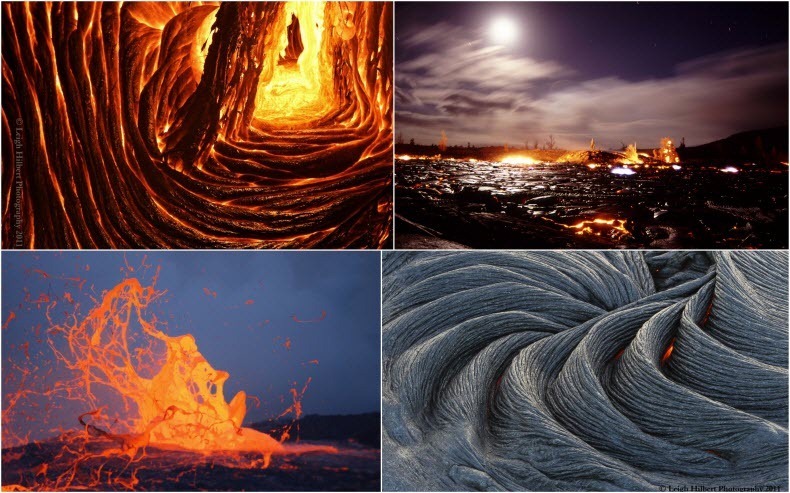
Spectacular Lava Landscape at Hawaii Volcanoes National Park


Remember that game “Hot Lava” that you used to play as a child? It would be real fun and challenging to play the game at Hawaii Volcanoes National Park, because here you don’t have to pretend the floor is lava. The ground actually is lava.
At the Hawaii Volcanoes National Park on the "Big Island" of Hawaii, you can watch the landscape change before your very eyes, thanks to Kilauea volcano, one of the most active volcanoes on earth. The park is also home to Mauna Loa, the world's most massive volcano. The park offers dramatic volcanic landscapes, flowing rivers of hot, molten lava as well as glimpses of rare flora and fauna. The chance to witness the primal process of creation and destruction make this park one of the most popular visitor attraction in Hawaii and a sacred place for Native Hawaiians.
Founded in 1916, the Park encompasses 333,000 acres from the summit of Maunaloa to the sea. Over half of the park is designated the Hawaii Volcanoes Wilderness area and provides unusual hiking and camping opportunities. Here you'll find 150 miles of hiking trails through volcanic craters, scalded deserts and rainforests as well as a museum, petroglyphs, a walk-in lava tube and two active volcanoes: Maunaloa, which last erupted in 1984 and Kilauea which has been erupting since January 3rd, 1983.
hawaii-volcanoes-park

Top 10 Animal Workaholics


This may surprise you, but ants have more of a purpose than putting a damper on your picnic. These industrious animals have workloads that may put your own to shame. In fact, many creatures work long days and nights just to survive in the wild, and if you think your 9-to-5 job is rough, a lot of these animals perform tasks that are very similar to jobs people do — though they may have completely different reasons for doing them and unique tools for getting the jobs done. Why do some birds, for example, work as interior decorators? And how do beavers construct giant lodges by chewing on tree bark? Find out what a regular workday is like in the animal kingdom for 10 of the most dedicated workers around.

10. Factory Workers: Ants
If you’ve ever had an ant farm, then you know an ant colony runs like a factory with well-defined roles and responsibilities. The queen ant’s only role is to reproduce, making her the sole producer of all ants born in a colony. A male ant’s only job is to mate with the queen, and unlike the queen, who lives for 15 to 20 years, males die shortly after mating. All of the other ants in the colony have specific jobs to keep it running smoothly. Worker ants are responsible for feeding and caring for the larvae produced by the queen, as well as keeping the colony clean, digging new tunnels and a variety of other tasks. Foraging ants are responsible for finding food and bringing their finds back to the colony. In addition to these roles, some ants act as security guards, scouting locations for the foragers and guarding the colony. While ants might appear to be nature’s nuisance, these tiny bugs eat dead insects and their underground tunnels help aerate soil, making them a vital part of any ecosystem.

Honey Hunters of Nepal


Honey hunting is one of the many activities that form part of the ancient culture of numerous civilizations. Scientists have estimated through rock painting documentation that honey hunting was practiced as far back as 13 000 BC. In Nepal, honey hunting has been practiced for thousands of years and is a vital part of the Nepali culture.
Some villagers in Nepal depend on honey hunting for their livelihood, and the country is home to the Apis laboriosa, which is the biggest honeybee on the planet. These bees construct their hives on the cliffs of the country’s foothills, and watching the honey hunters at work is a sight to be seen. Due to the location of the bee hives, honey hunters make use of rope ladders and baskets to get to the combs after the bees have been flushed out with smoke by lighting a fire underneath the hives.
Honey harvesting usually takes place twice a year, when honey hunters get together and head into the Himalayas to take on this massive task. To harvest one colony takes the honey hunters two to three hours depending on the location of the hive and its size.
honey-hunters-nepal

Top 10 Evil Actions By Usually Nice Countries

Some countries like Germany, Zimbabwe, Iraq, Iran just have a bad reputation.  There are, of course, others I won’t get into (I’m looking at you North Korea).  But other countries like Holland, Canada and most of Scandinavia are looked at as the good side of our small, orbiting pile of rock.  Yet these nations aren’t all squeaky-clean and polite.  No, some have some deep, dark, totally evil things they’ve done or are doing right now.

10.  Bhutan

lhotshampas
Bhutan is an isolated Buddhist country between China and India that forgoes measuring its progress by GDP in favor of GNH or “Gross National Happiness”.  Until 1999 they didn’t even allow Internet or TV, due to their supposed corrupting influences.  It’s all hippie love and Buddha statues…until you look at their policies towards minority ethnic groups.
In the 1990s the Bhutanese leaders decided that the GNH didn’t apply to one of its large minority groups, the Lhotshampas.  The Lhotshampas are ethnically Nepalese people who have been in Bhutan for generations, and were promptly ethnically cleansed from Bhutan territory.  At the point of a gun, over a hundred thousand people were forced from their homes that they had lived in for hundreds of years into refugee camps and poverty in Nepal and India.

123